

Learning how to calculate GPA takes one formula and one chart. You convert each letter grade into points, multiply those points by the credits the class carries, add everything up, and divide by your total credits. The result is your GPA. If you would rather skip the arithmetic, try our GPA calculator and see your number in seconds.
This guide shows how to calculate GPA from start to finish. You will get the formula, a grade-to-points chart, a full worked semester, and a way to turn percentage grades into GPA points. After that come the cases students ask about most: high school GPA, weighted and unweighted scales, and cumulative GPA over several terms.
Every example uses the common US 4.0 scale. Schools differ on plus and minus grades, weighting and rounding, so the GPA on your official transcript is the one that counts.
Quick answer: Here is how to calculate GPA in one line: convert each letter grade to grade points, multiply by the course credits, add up those quality points, then divide by the total credits. Example: 52.3 quality points ÷ 15 credits = 3.49.
Mini calculator (developer task): Add a small calculator here. Each row has an optional course name, a letter-grade dropdown and a credits field, with buttons to add and remove rows. Show the GPA to two decimals, the total credits and the total quality points. Include two optional fields, previous total credits and previous GPA, so students can get a cumulative result. Put a link to the full tool underneath. If the mini tool is not ready on launch day, publish a button box with the same link.
GPA Formula and Key Terms
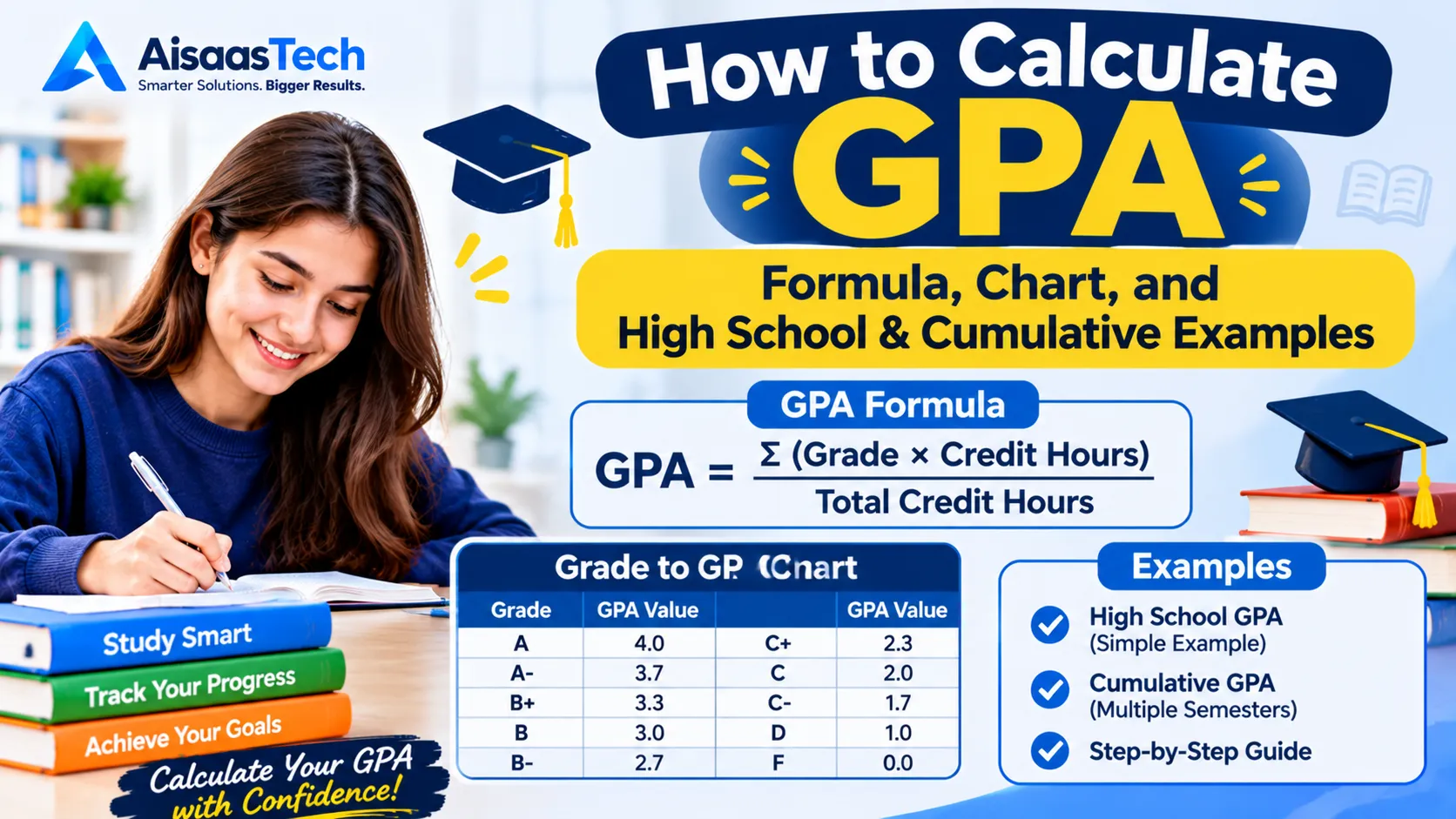
GPA = Total quality points ÷ Total credit hours
This one line is how to calculate GPA at almost any school that uses credit hours. Three terms show up in almost every GPA guide:
- Grade points: the number a school attaches to a letter grade, such as 4.0 for an A or 3.0 for a B.
- Credit hours (credits): how much weight a course carries. A lab science class might be 4 credits, while a gym class is 1.
- Quality points: grade points multiplied by credits. An A (4.0) in a 3-credit class earns 12.0 quality points.
Credits matter because they decide how hard each class pulls on your average. A 4-credit course moves your GPA four times as much as a 1-credit course. That is why a plain average of grade points gives the wrong answer.
A quick example shows the effect. Say you earn an A in a 4-credit class and a C in a 1-credit class. A plain average of 4.0 and 2.0 gives 3.0. The credit-weighted result is (4 × 4.0 + 1 × 2.0) ÷ 5 = 18.0 ÷ 5 = 3.6. This is how to calculate GPA correctly when credits differ: the bigger class counts for more.
Most schools report GPA to two decimals, but rounding rules differ. The registrar sets the official figure. The University of Notre Dame registrar, for example, publishes the same formula: quality points divided by credit hours attempted.
GPA Scale: Letter Grade to Grade Points
Before you learn how to calculate GPA, check which scale your school uses. Use this chart to turn letters into points. It shows the common 4.0 scale with plus and minus grades, plus the typical percentage range for each letter.
| Letter | Grade points | Typical percentage |
|---|---|---|
| A+ | 4.0 (some schools 4.3) | 97–100 |
| A | 4.0 | 93–96 |
| A− | 3.7 | 90–92 |
| B+ | 3.3 | 87–89 |
| B | 3.0 | 83–86 |
| B− | 2.7 | 80–82 |
| C+ | 2.3 | 77–79 |
| C | 2.0 | 73–76 |
| C− | 1.7 | 70–72 |
| D+ | 1.3 | 67–69 |
| D | 1.0 | 63–66 |
| D− | 0.7 | 60–62 |
| F | 0.0 | Below 60 |
A range such as 83–86 means 83% up to, but not including, 87%.
If your school does not use plus and minus grades, the scale is simpler: A is 4.0, B is 3.0, C is 2.0, D is 1.0 and F is 0.0.
An A+ equals 4.0 at many schools and 4.3 at some. Scales also differ between schools and countries. Some universities, for example, use 3.67 for an A−. Always use the scale in your own school’s policy.
How to Calculate GPA Step by Step
Here is how to calculate your GPA for a single semester. If you have ever asked how to calculate my GPA with real numbers, copy this layout. Example 1 uses five courses.
| Course | Credits | Grade | Points per credit | Quality points |
|---|---|---|---|---|
| English | 3 | A | 4.0 | 12.0 |
| Math | 4 | B+ | 3.3 | 13.2 |
| Biology | 4 | B | 3.0 | 12.0 |
| History | 3 | A− | 3.7 | 11.1 |
| PE | 1 | A | 4.0 | 4.0 |
| Total | 15 | 52.3 |
Follow these four steps:
- List your courses, credits and letter grades. The table above is a handy template.
- Convert each grade to points. Look each letter up in the chart: A is 4.0, B+ is 3.3, B is 3.0 and A− is 3.7.
- Find the quality points for each course. Multiply the points by the credits. English is 3 × 4.0 = 12.0, and Math is 4 × 3.3 = 13.2. All five courses add up to 52.3 quality points.
- Divide by the total credits. The credits add up to 15, so 52.3 ÷ 15 = 3.4867, which rounds to 3.49.
Check: 3.49 × 15 = 52.35, which matches 52.3 apart from rounding.
That is the full method for how to calculate GPA for one term. Notice how little the 1-credit PE class moves the result, while the 4-credit Math class has four times the pull.
How to Convert Percentage Grades to GPA
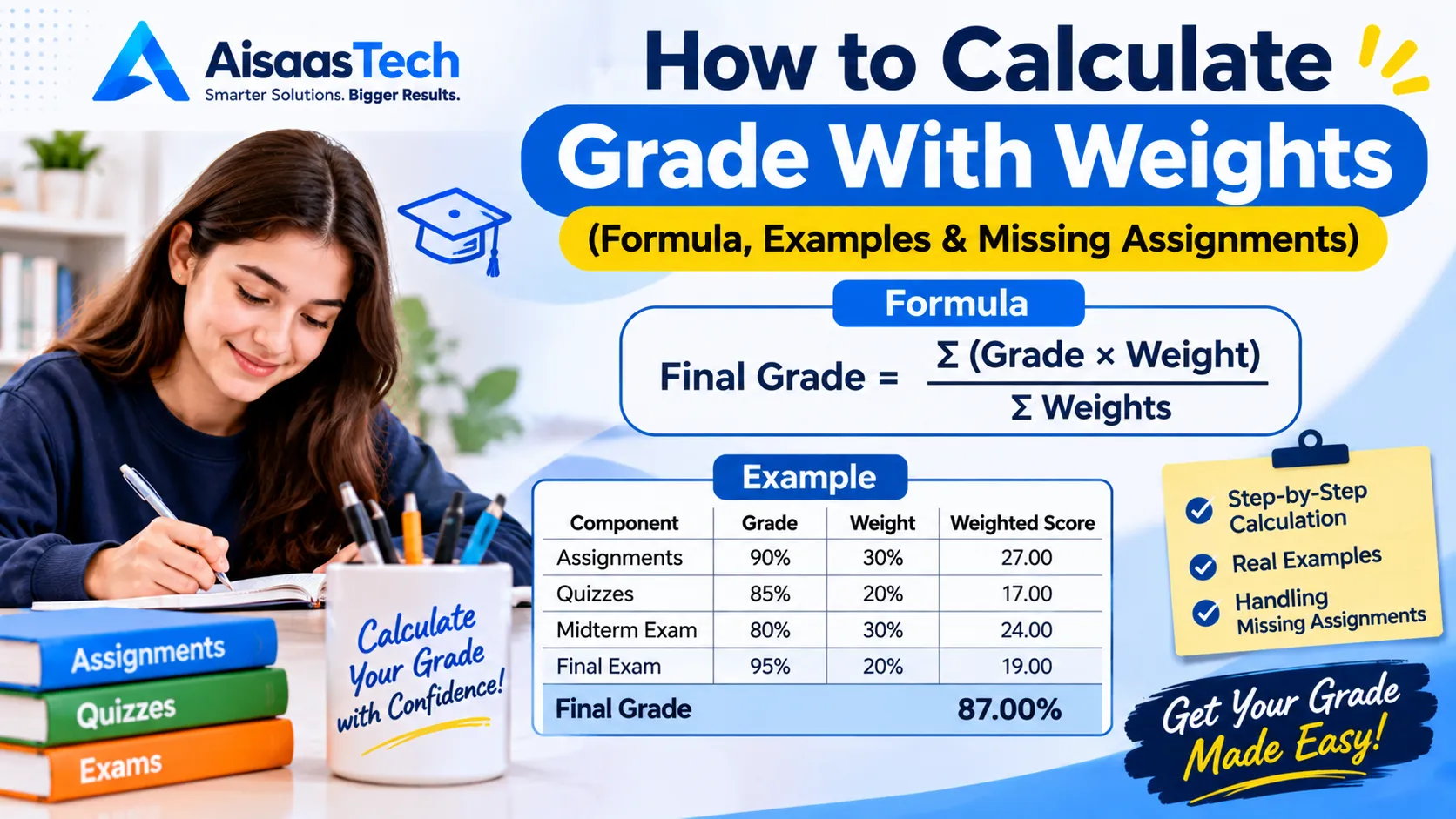
Many classes report a percentage instead of a letter. Convert the percentage to a letter with the chart above, then use the matching grade points. If you are unsure how to calculate GPA from percentages, the steps are the same once the conversion is done. If you still need the percentage itself, start with our guide on how to calculate your course grade with weights. You can also enter a percentage in our grade calculator to see its letter and GPA points.
Example 4. These percentages use the cutoffs from the chart.
| Course grade | Range | Letter | Grade points |
|---|---|---|---|
| 88% | 87–89 | B+ | 3.3 |
| 86.65% | 83–86 | B | 3.0 |
| 87% (rounded) | 87–89 | B+ | 3.3 |
The last two rows show why rounding matters. A teacher who rounds 86.65% up to 87% moves the course from a B to a B+. Ask which rule your school uses. Some schools do not round at all. Old Dominion University, for example, truncates GPAs instead of rounding them.
How to Calculate High School GPA (Weighted and Unweighted)
Here is how to calculate GPA in high school for both versions. An unweighted GPA uses the plain 4.0 scale, so an A is worth 4.0 in every class. A weighted GPA adds extra points for harder courses such as honors, AP or IB, so it can climb above 4.0.
The example below assumes AP courses add 1.0 and honors courses add 0.5. That is only an example. Every school sets its own extra weighting, and some schools do not weight at all, so use your school’s policy.
Most high school courses count as one credit, so you can add up the points and divide by the number of courses. Some schools use half credits. In that case, multiply the course’s points by 0.5 and count 0.5 in the total.
If your school mixes regular, honors and AP courses, work out how to calculate GPA twice: once with the plain scale and once with the extra points added. Then compare both results with the numbers on your transcript.
Example 3. Every course is worth 1 credit.
| Course | Grade | Unweighted | Weighted (AP +1.0, honors +0.5) |
|---|---|---|---|
| AP English | A | 4.0 | 5.0 |
| AP Calculus | B | 3.0 | 4.0 |
| Honors Chemistry | A | 4.0 | 4.5 |
| Spanish | B+ | 3.3 | 3.3 |
| PE | A | 4.0 | 4.0 |
| Art | A− | 3.7 | 3.7 |
| Total points | 22.0 | 24.5 |
Unweighted GPA = 22.0 ÷ 6 = 3.67. Weighted GPA = 24.5 ÷ 6 = 4.08.
Spanish, PE, and Art show the same value in both columns because they are regular courses with no extra weighting. Some colleges recalculate GPAs with their own method, so the number on your transcript may not be the one they use.
How to Calculate Cumulative GPA
Once you know how to calculate GPA for one term, the cumulative version is the same division over a longer list. Here is how to calculate cumulative GPA across several terms. Add all the quality points from every term, add all the credits from every term, and divide:
Cumulative GPA = Total quality points from all terms ÷ Total credits from all terms
Example 2. Semester 1 is the semester from Example 1. In semester 2, you take 12 credits and earn all A grades, so the quality points are 12 × 4.0 = 48.0.
| Term | Credits | Quality points | GPA |
|---|---|---|---|
| Semester 1 | 15 | 52.3 | 3.49 |
| Semester 2 | 12 | 48.0 | 4.00 |
| Total | 27 | 100.3 | 3.71 |
Cumulative GPA = (52.3 + 48.0) ÷ (15 + 12) = 100.3 ÷ 27 = 3.7148, which rounds to 3.71.
The common mistake. Averaging the two semester GPAs gives (3.4867 + 4.00) ÷ 2 = 3.7433, or 3.74. The two answers differ because semester 1 has more credits, so it should count for more. Registrars say this plainly: a cumulative GPA is not an average of term GPAs.
Already have a cumulative GPA and want to add a new term? Use this version:
New cumulative GPA = (Old GPA × Old credits + New quality points) ÷ (Old credits + New credits)
Check it with Example 2: (3.4867 × 15 + 48.0) ÷ 27 = (52.3 + 48.0) ÷ 27 = 3.71.
Planning the next term. You can also work backward. Suppose your cumulative GPA is 3.71 after 27 credits, and you want 3.80 after one more 15-credit term. The total after that term must be 3.80 × 42 = 159.6 quality points. You already hold 100.3, so the new term must supply 159.6 − 100.3 = 59.3 points. Divide by 15 credits and you get about 3.95. Most scales stop at 4.0, so a goal that needs more than 4.0 cannot be reached in one term.
What Counts Toward Your GPA?
Not every grade on a transcript is counted the same way. Before you work out how to calculate GPA, find out which grades your school includes. Policies differ, so do not assume a universal rule:
- Pass/fail courses: often left out of the GPA.
- Withdrawals: usually carry no grade points.
- Repeated courses: some schools replace the old grade, and others count both.
- Transfer credits: the credits may count, but the grades often do not.
Old Dominion University, for example, leaves out withdrawals, pass/fail grades and grades from other colleges. Your school may do it differently, so check its policy or ask the registrar.
Use Our Free GPA Calculator
Wondering how to find a GPA calculator that suits you? Look for one that lets you enter each course with its grade and credits, and that shows total credits, total quality points and the GPA to two decimals. Our free GPA calculator turns a course grade into a letter grade and GPA points, so you can compare its output with your hand work. Use it as a check after you have tried how to calculate GPA by hand.
Treat the result as an estimate. Your school’s registrar sets the official GPA. Looking for other helpers? Browse more free online tools on the site.
Common GPA Calculation Mistakes
These slips cause most wrong answers when students work out how to calculate GPA on their own:
- Ignoring credit hours and averaging grade points. Multiply by credits first, then divide by the total credits.
- Averaging semester GPAs. Add all the quality points and all the credits across terms instead.
- Using the wrong scale. Check whether your school uses plus and minus grades or straight letters.
- Mixing weighted and unweighted values. Pick one version and use it for every course.
- Forgetting that policies differ. Check your school’s scale, rounding and repeat-course rules.
Frequently Asked Questions
Here are quick answers to common questions about how to calculate GPA.
How do I calculate my GPA without credit hours?
Assume every course carries the same credit, then average the grade points. Add the points for all courses and divide by the number of courses. This matches the credit-weighted result only when the credits are equal. If credits differ, find them on your transcript or course list.
How do I calculate GPA on a 4.0 scale?
Convert each letter grade to points (A = 4.0, B = 3.0, C = 2.0, D = 1.0, F = 0.0), multiply by the credits, add the results, and divide by the total credits. Plus and minus grades use values such as 3.7 for an A− and 3.3 for a B+.
What is the difference between weighted and unweighted GPA?
Unweighted GPA uses the plain 4.0 scale, so an A is 4.0 in every class. Weighted GPA adds extra points for harder courses, such as honors or AP, so the top value can pass 4.0. Schools set their own weighting, so check yours.
How do I calculate my cumulative GPA?
Add the quality points from every term, add the credits from every term, then divide. Do not average the semester GPAs, because terms with more credits should count for more. In our example, 100.3 ÷ 27 = 3.71.
How do I convert my GPA to a percentage?
There is no single exact conversion, because schools use different scales. You can estimate by finding the percentage range for your letter grade, such as 83 to 86 for a B on the chart above.
Is calculating GPA different in high school and college?
The formula is the same: quality points divided by credits. High schools often count each class as one credit and may add weighting for honors or AP. Colleges usually use credit hours that differ by course and rarely weight difficulty. Always check the scale your own school uses.
Does a final exam grade change my GPA a lot?
Only if it moves your course into a different letter grade. A final worth 30% shifts your course grade far more than one worth 10%. To see which score you need, read our guide on what grade you need on your final.
Is the result from a GPA calculator official?
No. A calculator gives an estimate based on the grades and credits you enter. Your school’s registrar sets the official GPA, including its scale, rounding and treatment of repeated courses. Use the result for planning, and confirm anything important with your school.
Key Takeaways
- The core of how to calculate GPA is one formula: total quality points divided by total credits, where quality points are grade points times credits.
- For cumulative GPA, add all quality points and all credits across terms. Never average the semester GPAs.
- Weighted GPA adds extra points for honors, AP or IB courses, and each school sets its own weighting.
- Scales, rounding and policies differ, and your school’s official GPA is the one that counts.
Ready to try it? Calculate your own GPA in a few clicks.